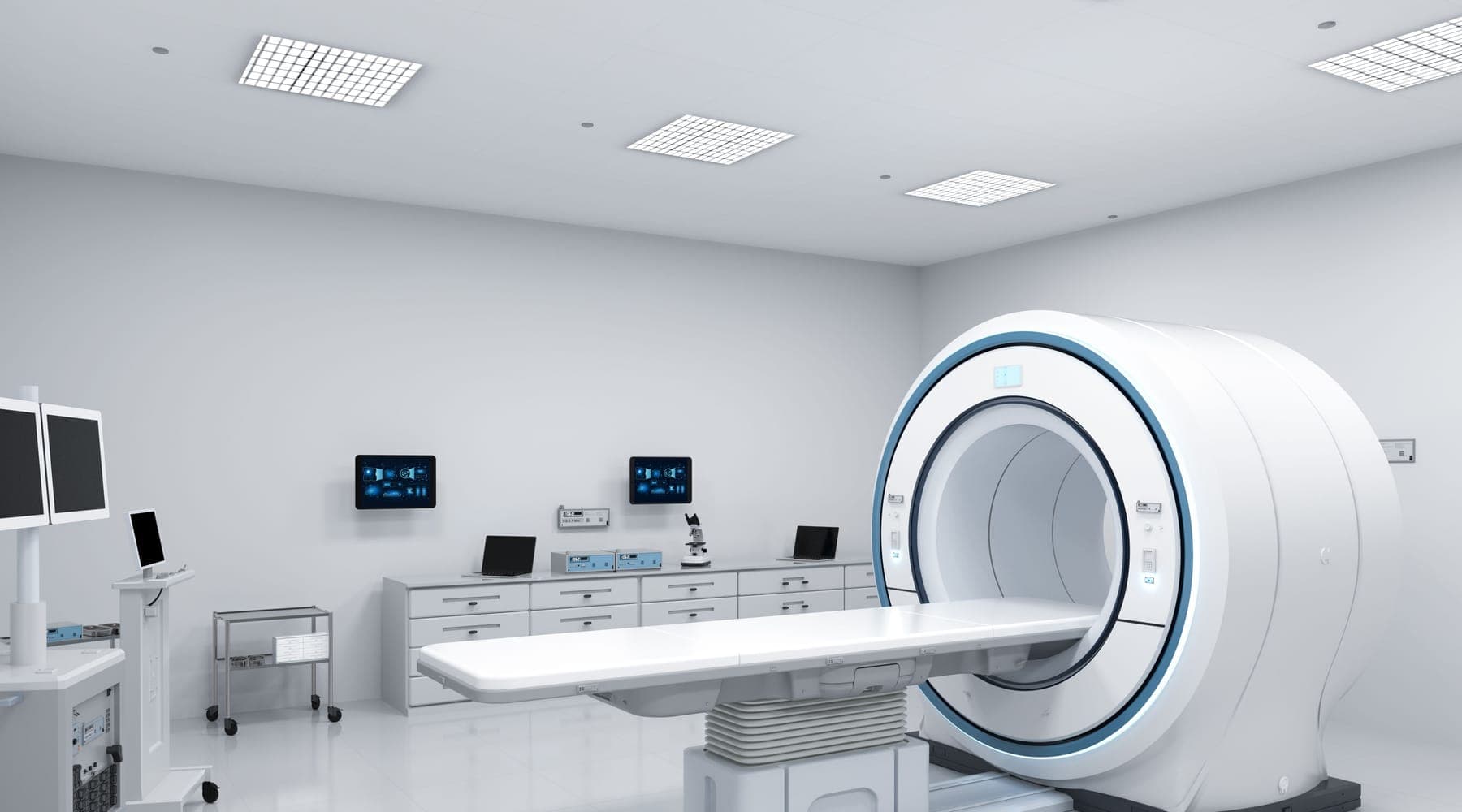
Major medical equipment decisions have to lead the design they drive
A scanner, a sterilizer or a compounding isolator sets the loads, shielding, utilities and data connections of the space around it. Chosen late, the room is designed around a guess.
Floor plans show an MRI suite or a sterile processing department as rooms with labels. The engineering behind those rooms is written by the equipment: what the slab must carry, how much lead or steel lines the walls, how much power and chilled water arrive, how wide the openings must be. A drawing completed before the equipment is chosen is a drawing of somebody's estimate.
That makes the major equipment list one of the owner's earliest design decisions, not a purchasing task that can trail the drawings.
A manufacturer's site requirements are design information
The equipment that reshapes a building tends to fall into a few families: diagnostic imaging and radiation therapy, surgical and interventional systems such as booms, lights and integrated rooms, sterile processing washers and sterilizers, pharmacy compounding hoods and isolators, laboratory analyzers, and in outpatient settings, dental operatories and their vacuum, compressed air and imaging. For each item the design team needs the manufacturer's actual site requirements: footprint and service clearance, weight and point loads, power and power quality, heat output, water quality and drainage, shielding, vibration and magnetic limits, and network connections.
Rule-of-thumb figures serve well enough while a program is still being sized. They stop serving once documents are being prepared for pricing and permits, because one vendor's unit can weigh more, run hotter or need more clearance than another's by more than the room was drawn to absorb.
Imaging rooms show the stakes most clearly
Rooms for X-ray, CT, interventional imaging and radiation therapy need shielding designed from the specific equipment and the expected workload, typically prepared by a qualified medical physicist and, in many states, reviewed by the state radiation control program before construction or use. A linear accelerator vault is a structural decision measured in feet of concrete.
MRI adds a different set of limits. The magnet's fringe field has to be kept clear of the public and of equipment it can disrupt, and moving ferrous masses such as elevators and vehicles nearby can degrade the image. The suite needs radio-frequency shielding, a quench vent route for cryogen-cooled magnets, controlled-access zoning of the kind set out in American College of Radiology safety guidance, and a structure stiff enough to meet the manufacturer's vibration criteria. None of these can be finalized without a selected magnet, and several are expensive or impossible to change after the structure is built.
Pharmacy compounding raises the same point from another direction. Under USP 797 and USP 800, sterile and hazardous-drug compounding depends on classified rooms, defined pressure relationships, air-change rates and external exhaust. The hoods and isolators the pharmacy selects drive that mechanical design, and the rooms require performance testing before they are used.
Responsibility for each item needs deciding as early as the item
Every piece of equipment needs an assignment: furnished and installed by the owner, furnished by the owner and installed by the builder, or furnished and installed by the builder. Each assignment determines who coordinates the rough-in, who receives and stores the item, who carries the risk while it waits, and whose schedule a late delivery disrupts. Gaps between those categories, such as an owner-furnished item whose final utility connections appear in no one's scope, are a predictable source of late cost. The responsibility matrix belongs in the bid documents, not in a meeting after award.
Lock the selection at a set point, then price every change
The workable discipline is a documented decision point for major equipment, placed before construction documents, after which any change passes through a formal review of its design, cost and schedule consequences. The pull against that discipline is legitimate: a department opening in three years wants the platform that will be current then, not the one current at schematic design. But a change after documents are complete is rarely a simple substitution. It can send the structural, electrical and shielding designers back to work and undo coordination that many trades have already built around.
Where a model genuinely has to stay open, the owner can still commit early to the physical limits that any eventual choice must respect: maximum weight and footprint, power and cooling capacity, shielding basis, ceiling support. The final purchase then happens inside boundaries the design already accommodates.
Order timing carries costs in both directions
An order placed too late misses installation and delays commissioning, acceptance and licensure. An order placed too early leaves the owner holding depreciating clinical technology in storage, paying to protect it, and sometimes watching its warranty run before any patient is seen. Where it can be negotiated, warranty coverage should begin when the equipment is accepted for patient use rather than when it arrives on a truck.
Long-lead equipment belongs on the project's master schedule, tied to the construction activities that depend on it, rather than on a separate departmental list. Large items often have to be set in place before walls or roofs close around them, and at that point an equipment delay becomes a construction delay.
The delivery route is part of the design
A machine has to physically reach its room. The route from the delivery point has to be confirmed during design: the width of every door and corridor, room to turn at each corner, what the elevators can lift and hold, whether each floor on the way can bear the load, and whether the structure or envelope must be opened temporarily. In an occupied building, that route also crosses patient areas and has to be planned with the same care as any other disruption, a subject covered in construction in an occupied facility.
Ready for patients means accepted, integrated and staffed
Switching a machine on proves little about patient use. Before first use, and varying by modality, the steps can include vendor acceptance testing, testing by a medical physicist, state registration, performance testing of compounding rooms, connection to the clinical record, imaging archive and scheduling systems through the facility's interfaces, network segmentation and security review for connected devices, and staff training. Many of these steps belong to vendors, physicists, regulators and the facility's own staff rather than the builder, and some cannot begin before the room is complete and clean. Each needs its own line in the schedule, with an honest duration.
Integration deserves particular attention. Equipment that works on its own but does not pass orders, images and results correctly to the clinical record cannot be used the way the department plans to use it. That data flow is worth testing before occupancy by someone other than the installing vendor. Several of the same items also gate regulatory approval, as set out in the approvals path on a healthcare project.
Equipment belongs in the readiness question
Major equipment can be one of the largest and least certain lines in a healthcare capital budget, and its decisions set much of the schedule. Whether selections, responsibility assignments, procurement dates and acceptance steps are defined before capital is committed is a central question for a readiness review and for independent budget review. The answer matters on a hospital imaging floor, and it matters just as much in an ambulatory surgery center or a veterinary hospital, where a short build schedule leaves even less room for a late machine.